Expert Occupational
Therapy Services for
Children in Hyderabad.
Medical Services
Rehab Services
Psychological Services
About Occupational Therapy
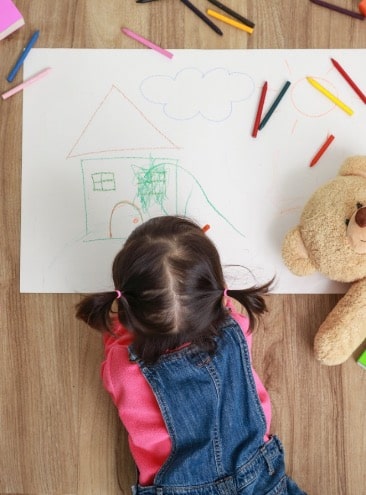
OT helps children enhance the skills required for physical, cognitive, and social development. In early child development, the first 3 years are critical as the child’s brain develops rapidly during this phase.
Our occupational therapists, using a play-based approach, engage your child in activities that develop important sensory, motor, behavioural, and thinking skills. Development in these areas improves performance in various daily activities, including dressing, feeding, writing, academic skills, play, and social participation.

Who Should Avail This Therapy:
Occupational therapy can help significantly with your child’s daily activities and challenges. Here are the signs that suggest your child might need to see an Occupational Therapist
1) Difficulty Achieving Age-Appropriate Milestones:
- Absence or delay in development of head and neck control, rolling, crawling, walking on time
- Difficulty in understanding and following instructions
- Lack of appropriate communication skills.
2) Inadequate play and social skills:
- Lack of initiating play
- Not exploring toys in appropriate way
- Repeatedly doing one type of play for hours
- Problems with imitative play
- Prefers to play alone or does not join other kids when playing.
- Not staying with one activity, but jumping from one interest to another.
- Does not understand the concept of sharing and turn taking.
- Trouble adjusting to new environments
- Problem coping in school.
- Difficulty in interacting with peers
- Avoids appropriate eye contact.
3) Difficulty in gross and fine motor skills:
- Gross motor skills involve whole body movement wherein large (core stabilizing) muscles of the body perform everyday functions like standing, walking, running, and sitting upright. This includes eye-hand coordination skills like ball throwing, catching, kicking. A child with low body tone and strength will display movements that are clumsy and uncoordinated. They may also have difficulty with:
- Climbing up and down stairs (age-appropriately)
- Coordinating both sides of the body
- Poor balance and coordination
- Poor endurance gets tired easily and avoids physical games and activities
- Difficulty in understanding the concept of right and left
- Difficulty in ball rolling, throwing, catching, or kicking
- Fine motor skills include writing, cutting, holding different sized objects, picking up a spoon, tying shoelaces etc. The development of these skills relies on the age-appropriate development of gross skills of core muscle strength, postural /trunk control, and shoulder strength.
If your child is struggling with fine motor skills, they may have difficulty with:- Developing hand dominance
- Using both hands appropriately
- Manipulating toys and puzzles
- Gripping a pencil, crayon/scissors appropriately
- Poor handwriting (letter/number formation)
- Colouring, Drawing, tracing, pre-writing shapes
- In dressing using buttons, zippers, typing shoelaces
- In tasks and games that require fine movements of fingers and wrists
4) Sensory Processing challenges involve decoding the information that our senses provide (smell, sound, touch, vision, body movement and position). If your child often seems very sensitive to their environment, it may be a problem with sensory processing. Common problems include:
- Reacting intensely to touch, movement, or sound
- Constant jumping, bumping, moving, and crashing.
- Trouble handling changes in the environment.
- Showing less than normal response to specific sensations, like a high tolerance for pain or not noticing cuts and bruises or trouble in hair / nail cutting, head and face wash.
- Generating appropriate responses when upset
- Getting distracted too easily by sights and sounds.
- Reacting with very strong emotions.
- Easily distracted
- Reversing letters and numbers, even after age 7
- Controlling impulsivity poorly
- Struggling to concentrate and focus in the classroom
- Difficulty in learning new information
- Being either hyperactive or low energy
- Falling behind with homework
- Exhaustion after schoolwork
- Trouble figuring out directions and finishing task.
- Birth injuries or birth defects
- Sensory processing disorders
- Learning disabilities
- Autism/Pervasive developmental disabilities
- Developmental delays
- ADHD/ ADD
- Spina bifida
- Down Syndrome
- Severe hand injuries
- Other neurological and genetic disorders.
Benefits

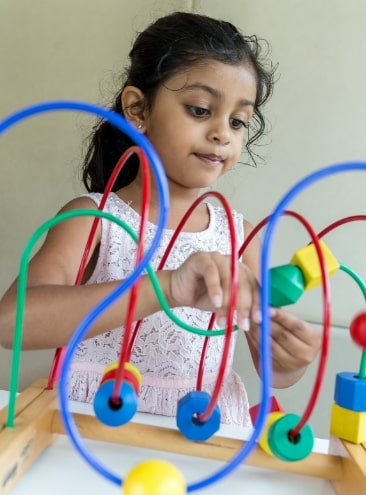
- Occupational therapy helps children become as functional and independent as possible. Therapists take a holistic approach where therapy is family centred.
- Therapists first determine the child’s strengths, challenges, and the various tasks that they find challenging. After which, they create a program of activities for the child made to achieve set goals directed toward the child’s independence.
- OT helps children develop the following skills:
- Fine motor skills (writing, self-care, brushing, dressing, buttoning etc.)
- Gross Motor skills (balance and coordination, throwing and catching a ball, riding cycle.)
- Visual perceptual skills (visual attention, visual memory, figure – ground perception, visual closure, which is required for reading, writing and play activities)
- Motor planning (hand-eye coordination skills, like writing and copying, holding, and writing with a pencil, organizing skills)
- Self-regulation skills (child’s responses to sensory inputs)
- Play and social skills (functional play, turn taking, sharing, expressing emotions, understanding social cues)
- Executive functioning skills (attention, organization, initiation, sequencing, memory to improve academic performance and ability to complete daily routine independently).
- Also provides sound guidance to caregivers and teachers. Home programmes help the child carry over skills learned in therapy to the home and classroom.

Process

- History taking via parent interaction and observing the child in a therapy setting area, without structured activities (1 hr session). The formal / informal assessments are done according to the needs of the child.
- Before commencing the therapy sessions, 3 months goal setting with parents, according to the child’s need and family concerns.
- Sessions are 45 – 50 mins long. Every session is closed with a 10 mins interaction with the parent(s)· Goal setting and therapy for the child, including home programmes.
* Parents are an integral part of all therapy sessions and goal settings.

Know your therapists





Varnam CDC Online Services
Our online consulting service enables you to have your child’s consultation from the convenience of your home, via video call.